The Complete Custom Software Development Process: From Idea to Deployment

|
Gone are the days when companies were comfortable holding onto their legacy systems and letting them carry out core processes. Now more than 70% of CxOs worldwide are ready to put legacy system modernization at the top of their priority list, yet somehow many custom software projects fail.
Why? Definitely not because they are inherently a bad idea. However, the execution is often not right. Unclear processes combined with the lack of a structured approach can cause timelines to slip out of control and budgets to balloon while expectations drift.
The only way to get your project back on track is to have a clear software development process – and that extends way beyond choosing your development methodology.
In this blog, Vestra Inet – a trusted software development partner for several businesses in Toronto – will show you how having a clear, well-defined process can bring predictability, transparency, and accountability to every stage of your custom software initiative.
What Is The Custom Software Development Process?
The custom software development process is a lot simpler than you think. In fact, it is very similar to a brand manifesto in a lot of ways. Let us explain.
Definition and purpose
This process entails the formulation of a structured framework that clearly outlines how a particular piece of software will be planned, designed, built, tested, and deployed to ensure it meets the needs of your business.
Its core purpose is to ensure every single stage of the process, whether it’s technical or strategic, aligns with your organization's broad goals, thus resulting in a software that supports long-term growth and scalability.
Who needs a defined process and why?
Every company that plans on getting custom software to optimize its internal workflows needs a defined process backing up this initiative. So whether your company is a start-up or an enterprise, if you want to keep stakeholders on the same page and prevent scope creep, having a framework is a must.
Common misconceptions about software development
Even though it is a commonly held belief, software development is not purely technical or linear. In fact, it is highly fluid in nature, taking a rather iterative and collaborative approach that relies heavily on planning, communication, and continuous validation.
Let’s cover each phase one by one so you know exactly what it is all about.
Phase 1: Ideation, Discovery, & Requirement Analysis
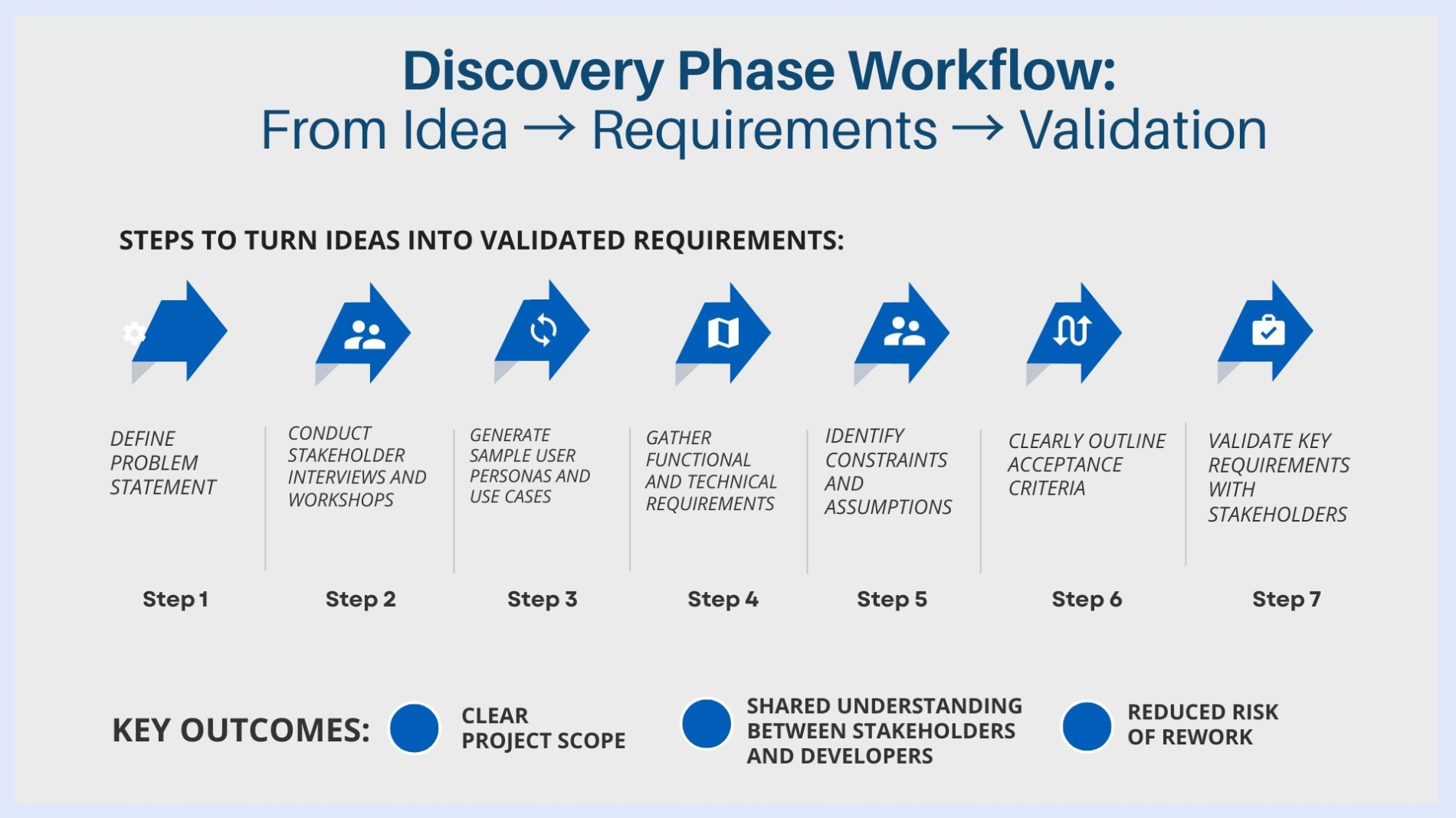
The starting point of success for any custom software development project, the discovery phase is unskippable. A collaborative process, a good company, like Vestra Inet, will rope you in to ensure the right ideas get validated while your business goals are translated into clear, actionable requirements.
Understanding the business problem
There is a core issue that is acting as a stumbling block in your business’s growth. The discovery phase is about, well, “discovering” what that issue is, so the software developed can address it appropriately. Identifying this challenge involves analyzing your company’s current workflows, inefficiencies, and user pain points while validating them against desired outcomes.
Requirement workshops and documentation
The discovery phase doesn’t stop there, though. It extends to cover workshops, interviews, and audits to ensure both functional and non-functional requirements are adequately captured. For example, at Vestra Inet., we use these requirements to develop the scope and timelines for your custom software project.
User persona and use-case identification
Defining user personas and use-case scenarios is an integral part of the development process we follow. It helps us in building software that is designed around how your team actually works, thus boosting its usability and adoption.
Discovery Phase Checklist
We keep our discovery process simple, collaborative, and effective:
- We clarify your business goals and success metrics
- We outline your company’s workflows and the software’s primary users
- We identify technical and operational constraints with your input
- And we finalize your requirements and acceptance criteria
Phase 2: Planning, Scoping & Estimation
Moving onto the next stage of software development, planning and scoping keep your project on track by creating a realistic execution roadmap that ensures perfect alignment between your business’s expectations and budget, and the software’s technical feasibility and timeline.
The result? No nasty surprises – neither for stakeholders nor developers.
Project scope and feature prioritization
At Vestra Inet, we have mastered the art of project scoping. After reviewing your full list of requirements, we create a structured scope that allows us to categorize features based on your priority. This way, our team gets clarity on must-have vs. nice-to-have features so they can start work accordingly.
Timeline and sprint planning
Based on the scope, we choose the most suitable development methodology for your software. Typically, it is a mix of Agile or hybrid methodologies as they help us plan the most efficient sprints, complete with defined deliverables, review points, and feedback loops.
Budget and resource alignment
Our custom software development services are made to fit into your budget. Based on its scope, complexity, integrations, and risks, we put our best minds in the fields of design, development, and project management to work, thus avoiding unexpected costs and detours.
Our software project planning process covers the following steps:
- Devising a detailed scope
- Prioritizing MVP features
- Defining key milestones and timelines
- Providing realistic development cycle estimates
This is how we ensure that every member of our team works in sync to build high-quality software for you.
Phase 3: UX/UI Design & Prototyping
Now that the path is clear, our team gets cracking on actually designing and prototyping the solution you ordered. This is one of the most exciting phases in the custom software lifecycle as it focuses on translating your requirements into an intuitive UI so you can witness its potential impact in real-time!
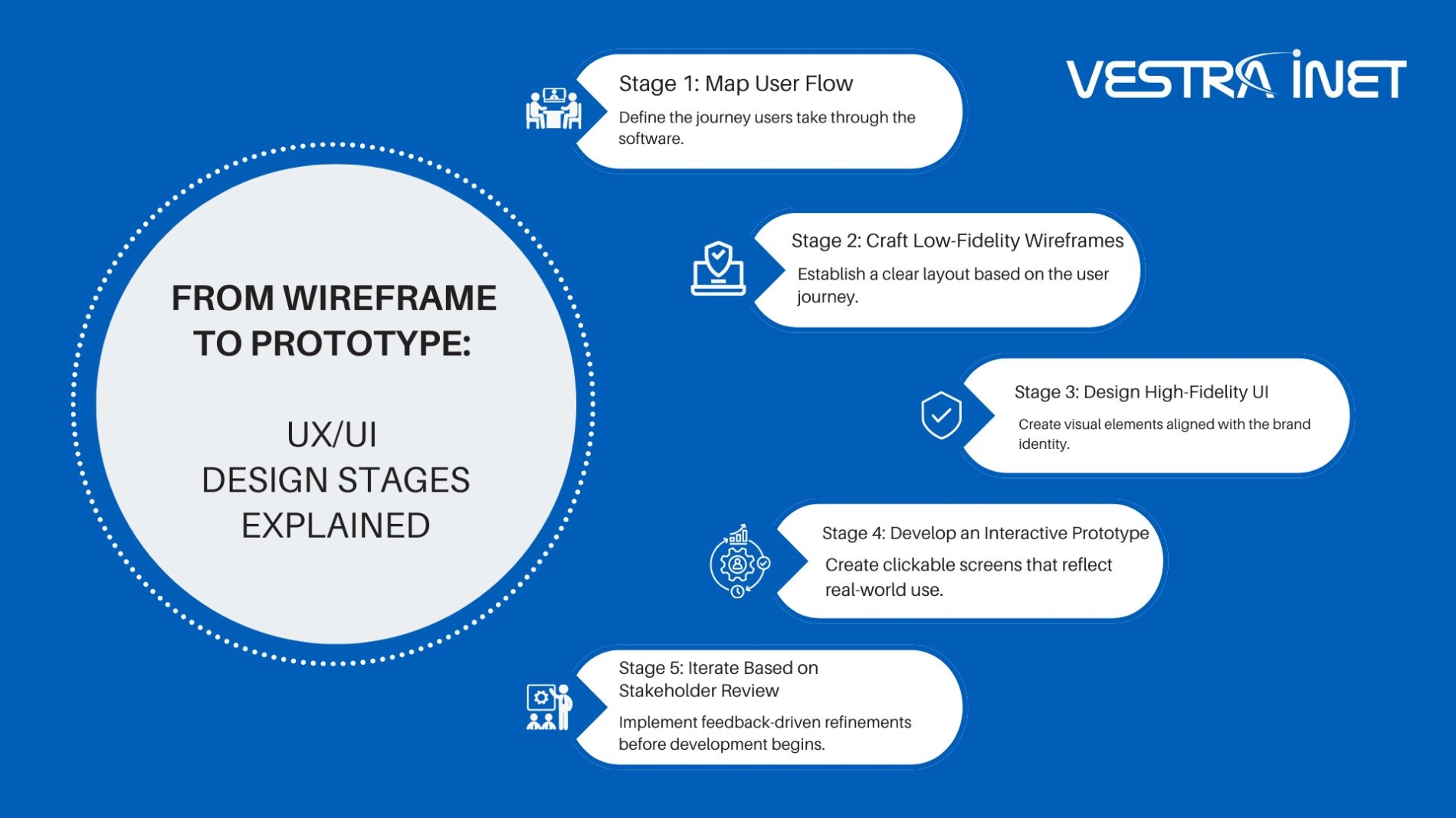
Wireframes, user journeys, and interface flows
The first thing our designers do is develop a low-fidelity wireframe to clearly map out the individual workflows, navigation paths, screens, and user interactions that will form the core component of your software. Once formed, this wireframe is shared with you so you can track the logic of the software and your user’s journey through the proposed system.
Visual prototyping and brand alignment
Once we get your approval for the wireframe, we move on to the next software development step: creating a high-fidelity prototype with clickable elements. You can be rest assured that each of these elements will reflect your brand’s identity, including its fonts, colors, etc.
Stakeholder review and iteration cycles
Before we write a single line of code, we will send in the prototype for your review. You can check its design, provide feedback, and request refinements. The goal is to keep the entire process as collaborative as possible so there are minimal misunderstandings during the actual development stage.
Phase 4: Software Development & Coding
Of the entire software project planning process, this is the main stage. This is where our developers use your approved designs as the foundation for building a working software that fulfills your company’s requirements and supports its digital transformation. Of course, it is an iterative process – and we prioritize quality, flexibility, and transparency through it all.
Agile sprints and iterative development
To make software development simpler and faster, we divide the whole project into short sprints. Each sprint focuses on developing a specific feature or module, which is submitted for your review so you can check if it aligns with your business’s goals and user expectations.
Backend, frontend, and database buildout
We take a layered approach to development, ensuring all bases are covered:
- Our backend developers tackle the security, integrations, business logic, and APIs of your software
- Our frontend team focuses on designing its UX/UI to ensure every element is responsive and user-friendly
- Lastly, our database developers concern themselves with building structured, scalable, and secure data storage
Keeping it divided helps us build modules that sync with the software’s overall architecture to form a comprehensive ecosystem.
Code reviews, version controls, and standards
Quality is paramount for us too, which is why at every stage our developers follow strict coding standards. We also conduct peer code reviews and use version control systems to maintain quality and stability, and to identify issues early on so they can be appropriately rectified.
Phase 5: Quality Assurance & Testing
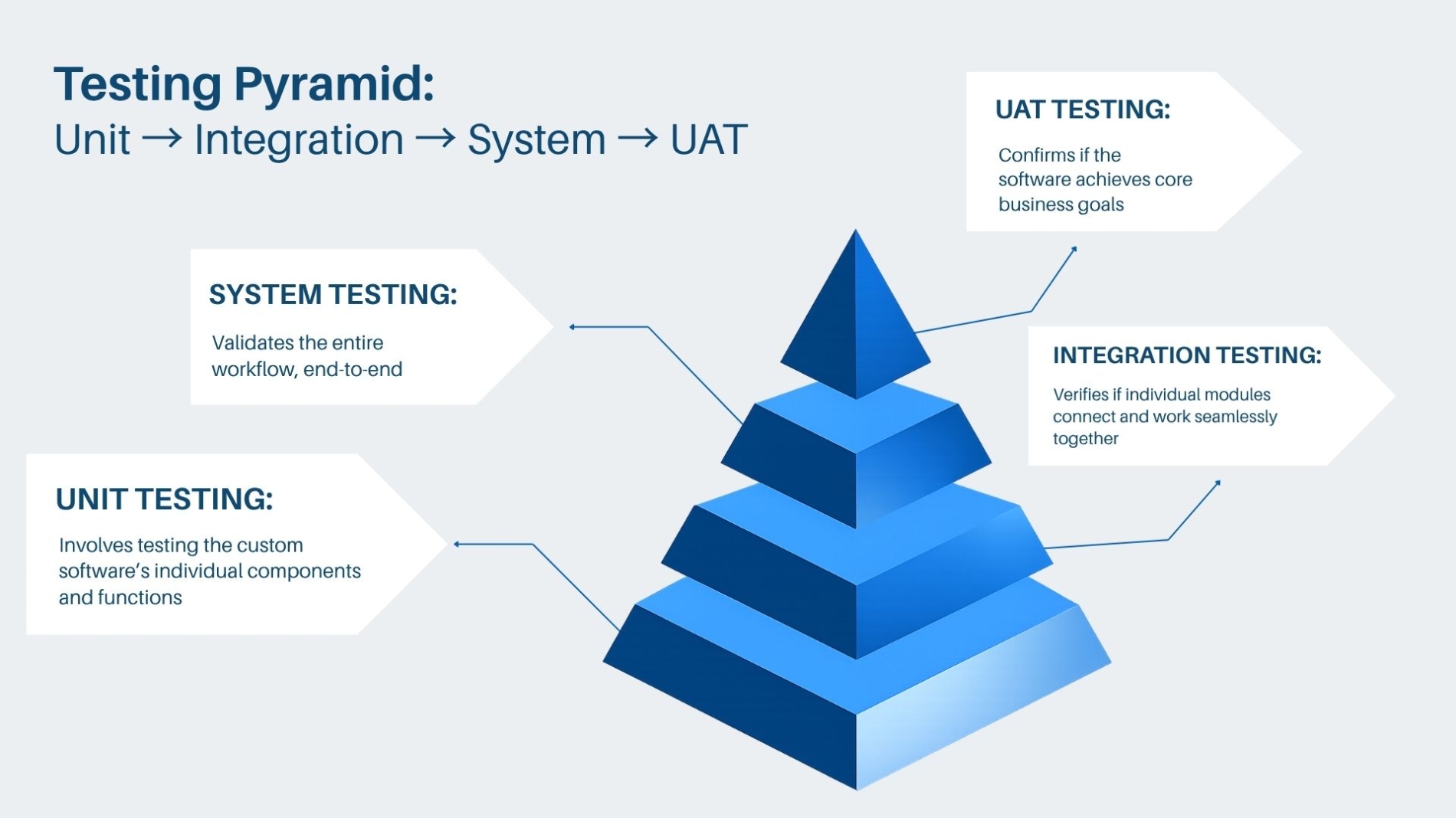
We are just as committed to building software that works as intended, and that is why we have strict quality tests in place. By performing rigorous checks, we get to internally validate your software’s performance, functionality, security, and usability before we can have you review it.
Functional, integration, and regression testing
The first thing our QA team does is verify if each of the features or modules developed fully matches your requirements. To ensure they do, we carry out a functional test that checks the performance of individual features. We then move on to an integration test to ensure modules, APIs, etc, sync and work seamlessly. Lastly, we conduct a regression test, which confirms the ability of the system to tackle new changes without breaking down.
Automated vs manual testing
The purpose of automated tests is to validate if repetitive tasks such as data processing, calculations, and performance checks are conducted in an error-free manner. As for manual testing, we reserve it to get feedback for user experience, edge cases, and real-world scenarios.
Bug tracking and resolution
Quality checks tend to reveal bugs and inconsistencies, which we carefully log, prioritize, and resolve during our internal review of the developed custom software. We also retest the fix to ensure everything works as expected.
Phase 6: Deployment, Launch & Production Rollout
The phase that you (and most of our clients) eagerly wait for, deployment marks the implementation of a live system that is ready for take off!
Once implemented, the focus shifts to user training and delivering consistent performance and stability while ensuring minimal disruption so your business can function as is but better.
Preparing the release build
Before we send the final version to you for rollout, we package the entire software along with its approved features, configurations, and security settings so its readiness can be validated. This step also involves double-checking user roles, integrations, and data migration scripts.
Staging vs. production deployment
We like to be thorough. So we subject the custom software we have created for you to a staging environment that mimics your organization's workflows. Consider it as the final check we need to tick off the last box so it can actually be deployed. We recommend you follow a phased rollout plan so your team and your business get enough time to adapt to it.
Post-launch monitoring and issue resolution
Once the system is live, our team will carefully track its performance and maintain a detailed log of errors and user activity so any post-launch issues can be addressed promptly.
For us, the entire process of deployment looks like this:
- We prepare a CI/CD pipeline that aligns with your timeline
- We deploy the staging build to validate individual features
- We send the final package to you, ready for launch
- We monitor KPIs and system health post-deployment on your end
Phase 7: Maintenance, Optimization & Feature Enhancements
Our journey with you does not end after custom software deployment. We provide continuous support in the form of updates, refinements, and patch fixes to ensure the application we built for you maintains its security and performance in the long run.
Ongoing support structure
Whether it is a fix to quash bugs or a security patch, we regularly send out updates to prevent downtime and disruption. We also regularly check in with you to ensure the new updates align with your organizational goals.
Performance monitoring and scaling
We continuously monitor the performance of the application we designed for you through logs, analytics, and uptime metrics. Each of these reveals areas for refinement and optimization, which we then send patches for. We also scale the app for your organization without compromising its speed and reliability.
Continuous improvement and roadmap planning
We plan future enhancements using analytics, user feedback, and your business’s evolving goals as our guide. Every new feature, improvement, and integration is the result of careful planning and coordination, so you can trust our software to grow alongside your business.
Real-World Example: Successful Custom Software Development Implementation
Over the last 20 years, Vestra Inet has helped 550+ businesses transform their operations with the help of our custom software. We have taken the same careful approach with each of them – from starting off with a detailed discovery call to providing continuous post-launch support – we never skip a single step.
Recently, we had the chance to prove our mettle again with Borden Gratings, adding yet another successful custom software development implementation program to our hats.
Project overview
Borden Gratings, a reputable supplier of all kinds of grating systems in Canada, was struggling to manage its complex inventory, manufacturing processes, and sales operations. They required a comprehensive software that could streamline all three processes and sync them to achieve complete transparency and visibility.
Development approach
Our team took up the challenge to design a centralized custom software system for them that would address all of their pain points. However, before we got started, we indulged in meticulous requirement gathering to ensure we skipped no details. Post-discovery, we developed a detailed project scope for them, based on which we drew up refined prototypes that the company could review. We worked very closely with Borden Gratings, taking their feedback into account every step of the way.
Key outcomes and learnings
Building a dedicated ERP system for Borden Gratings was not without its challenges. Their extensive inventory was tough to consolidate and organize into a coherent whole. However, with their input and the skills of our team, we were able to craft a highly complex, advanced, yet simple-to-use software for them that covered several modules – from a quotation system to a price calculator and beyond.
Conclusion
With all the SDLC phases explained, you can now see how critical each step is. Whether it is a detailed discovery call, a clearly defined scope, prototyping, development, or testing – every single stage gives structure to your software development initiative. For businesses, this is a complete win as they gain predictability, transparency, and control at every stage.
If you wish to take advantage of this disciplined, risk-free approach for your legacy modernization project, turn to us. Vestra Inet has over 20 years of experience in developing sophisticated custom software for manufacturers, fabricators, and service providers in Ontario. Contact us to get properly planned and executed systems.
FAQs
What is the custom software development process?
Defined as a structured, end-to-end approach, the custom software development process primarily concerns itself with the designing, building, testing, deploying, and maintaining of custom software for enterprises.
What is included in the planning phase of custom software development?
The planning phase of custom software development covers a few critical steps such as project scoping, feature prioritization, budget and timeline estimates, resource planning, and risk assessment.
Why choose custom software instead of off-the-shelf tools?
Custom software is the smarter choice as it is built to match your current workflows, sync with your business goals, and integrate with your software suite without any limitations.
How does custom software ensure scalability and integration?
Custom software has scalability built into its code. It also seamlessly connects to your existing set of tools, including the ERP, CRM, and other third-party APIs your company relies on.
Does the development process change when hiring a Toronto-based team?
While the core phases of software development do not change, it becomes easier for Canadian businesses to stay compliant and get locally relevant solutions with Toronto-based software development teams.
What affects the timeline of a custom software project?
Multiple factors can influence the timeline of a software project, including its scope, inherent complexity, integrations, and review and approval cycles from key stakeholders.
Author Bio

Andrey Wool
Helming the operations at Vestra Inet, Andrey has over 20 years of leadership experience in the ERP industry. Having successfully launched 550+ software projects across a diverse set of industries, Andrey continues to transform the way businesses function with pioneering custom software solutions. His in-depth knowledge of sectors such as manufacturing and distribution has helped him curate actionable solutions that eliminate bottlenecks and pave the way for sustainable growth.